




Some career tests measure consistently, and many don't publish anything that shows it. CareerFitter's preliminary 2026 reliability study found an average of .77, with scales reaching .86, across 374,000+ completed assessments.
When you take a career assessment, you are trusting it with a big question: what kind of work fits me? You deserve to know whether the tool behind your results measures things consistently. That is why, in 2026, CareerFitter's psychology team ran an Internal Consistency Reliability Study of the CareerFitter work personality assessment, and I reviewed it. These results are preliminary, and further research, including a retest, is underway. CareerFitter is using this first round of reliability results to update the assessment, with a retest planned in about 4 weeks, and we expect the scores to improve further. Here is how the study worked, what it found, and what comes next.
How to tell if a career test is accurate
Reliability is about consistency. On a reliable scale, the questions that are meant to measure the same trait actually move together. If they don't, your results can say more about random noise than about you. Reliability is one part of accuracy, and a good first question to ask any assessment is whether it publishes its reliability results.
My background is in positive psychology and performance psychology, and I care about one practical outcome: helping people find work that uses their real strengths. That only works if the measurement underneath is steady. Before anyone makes a career decision based on an assessment, the assessment should earn that trust.

How the study was run
The psychology team used the Kuder-Richardson Formula 20, known as KR-20. It is a standard method from classical test theory for measuring internal consistency, and it is the dichotomous-item case of Cronbach's alpha (Cronbach, 1951).
Here is how the study was set up:
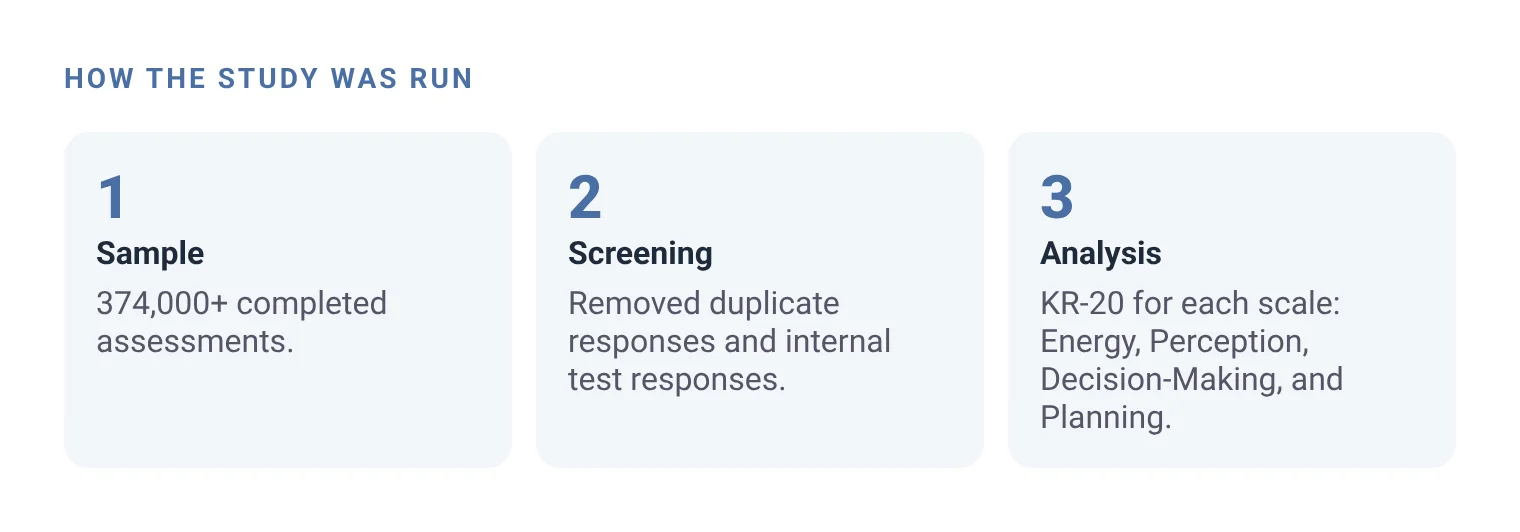
- Sample: 374,000+ completed assessments.
- Screening: the team removed duplicate responses and internal test responses, so the data reflects real people completing the assessment.
- Analysis: the team computed KR-20 coefficients separately for each of CareerFitter's four work personality scales: Energy, Perception, Decision-Making, and Planning.
What the study found
CareerFitter's four scales averaged .77 (KR-20) on 374,000+ completed assessments, with a high of .86.
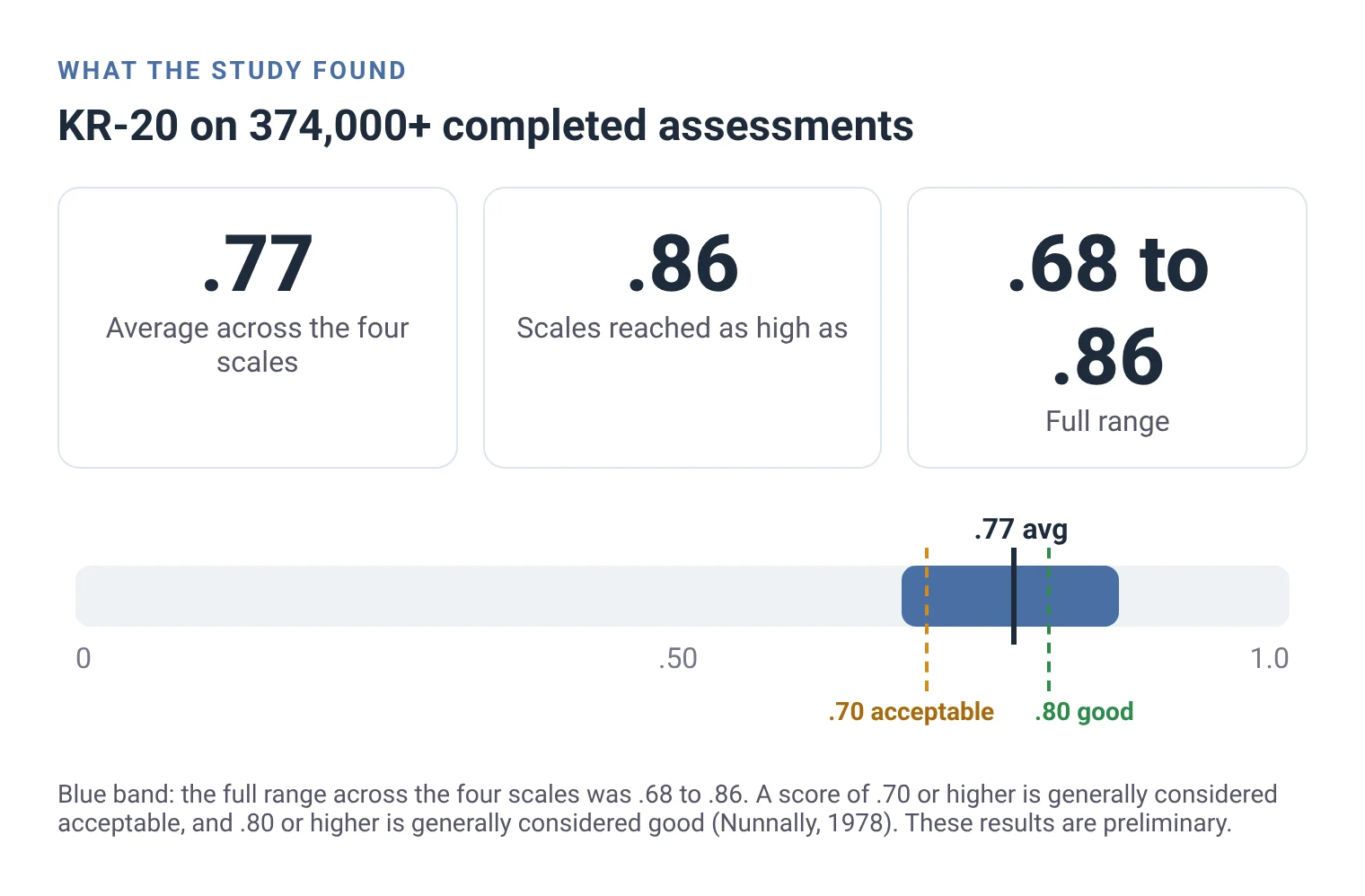
- The average across the four scales was .77.
- Scales reached as high as .86.
- The full range across the four scales was .68 to .86.
- A score of .70 or higher is generally considered acceptable, and .80 or higher is generally considered good (Nunnally, 1978).
The .77 average sits above the generally accepted .70 level, and the strongest scale reached .86. I am encouraged by these results. They show that, across a very large sample, the items on CareerFitter's scales hold together in a consistent way.
What these results do and do not mean
Internal consistency shows that the questions on each scale work together to measure the same trait. It's one useful piece of the picture, and there's more to learn about how results relate to real career outcomes. That's what the deeper validation study now in progress is designed to explore. CareerFitter's earlier research explored construct and criterion-related questions, and the next step is a formal study built for today's assessment. I would rather share honest, preliminary numbers now than overstate what we know. Guided by this first round of reliability results, CareerFitter is updating the assessment and plans to retest in about 4 weeks. We anticipate the scores will improve further, though that is an expectation, not a guarantee.
I would rather share honest, preliminary numbers now than overstate what we know.
Why, in my professional opinion, CareerFitter is the best career assessment
In my professional opinion, CareerFitter is the best career assessment available today. That is my personal, professional view as the researcher who reviewed this study, not a proven fact, and I want to explain why I hold it.
It starts with transparency. CareerFitter publishes its reliability method, its sample size, and its full range of scale scores. Combined with more than 25 years of research and development since 1998, a 1998 disparate impact study conducted following APA and SIOP standards, and occupational research across 1,000+ careers, this is a foundation built to keep improving.

What popular career tests publish about reliability
In my professional view, not all career tests measure the same thing. Interest profilers, such as the government's O*NET Interest Profiler, are a simpler type of tool that helps you organize your thoughts about what you enjoy. CareerFitter is a different, more in-depth hybrid assessment. It measures your work personality and also your preferences around those personality traits. Then the Aptitude Aversion Assessment screens for additional career characteristics. CareerFitter's proprietary algorithms combine all of these results, along with O*NET occupational data, to match you with careers and give each one a FIT Score. Because these tools measure different things, I don't think it is meaningful to rank or score them side by side.
As of October 26, 2026, we reviewed what several popular career tests publish about reliability on their public pages. Here is what we found, limited to the pages we checked:
- Make the Leap AI career test, Princeton Review Career Quiz, and BigFuture Career Quiz: we could not find published reliability data for these tests on the pages we checked.
- Truity Career Personality Profiler: its page describes the test's reliability as excellent, but we could not find published reliability figures, such as coefficients or sample sizes, on the pages we checked.
- 123test: it publishes research on a different test (a technical report from a Big Five personality study), but we could not find published reliability data for its career test on the pages we checked.
- Apt (an AI chat career test): its FAQ describes the tool as grounded in personality and aptitude science and accurate, but we did not find reliability figures or a method on the pages we checked.
- Psychology.com Career Aptitude Test: it describes itself as an adaptation of an existing interest profiler and points to that original instrument's research, but we did not find reliability figures for its own version.
- Open-Source Psychometrics RIASEC test: it names the published item set it is based on, but we did not find reliability figures on its test page.
- Pigment career test: we could not find published reliability data. Its own methodology page says openly that large-sample reliability data has not yet been published and that formal validation work is underway.
- My Career Path: it does publish its own figures: Cronbach's alpha by scale ranging from .65 to .76 from 3,987 sittings, with three of six scales below .70, according to its methodology page.
This is not a claim that any of these tools are poor, and it is not a claim that CareerFitter outperforms them. It is simply a reminder that you can ask any career test what it publishes about how consistently it measures.
CareerFitter shares how its scales were tested, on how many completed assessments, and what the results were, while being honest that those results are preliminary and that further research, including a retest, is underway. For you, that means a work personality assessment grounded in research, with results you can use to explore careers that fit how you naturally work.
Take the CareerFitter career test

Learn more about the research
You can read the full background, including the 1998 disparate impact study, the four work personality dimensions, and the details of the 2026 study, on CareerFitter's Research and Development page.
Frequently Asked Questions
Are career tests accurate?
It depends on the test, and a good sign is whether it publishes reliability data you can check. CareerFitter's preliminary 2026 results average .77, with scales reaching .86, on 374,000+ completed assessments.
What do CareerFitter's reliability scores mean?
They show how consistently people answer the items on each scale. CareerFitter's scales averaged .77, with scales reaching .86, across 374,000+ completed assessments. A score of .70 or higher is generally considered acceptable.
How was reliability measured?
CareerFitter's psychology team used the Kuder-Richardson Formula 20 (KR-20) on 374,000+ completed assessments, after removing duplicate and internal test responses.
Are these final results?
No. The results are preliminary, and further research, including a retest, is underway.
What happens next?
Guided by this first round of reliability results, CareerFitter is updating the assessment and plans to retest in about 4 weeks. We anticipate the scores will improve, and further research, including a retest, is underway.
Who conducted the study?
CareerFitter's psychology team ran the analysis, and I reviewed it. I am Dr. Will Cunningham, and I contribute to CareerFitter's ongoing research and development.
How can I see my own results?
Start the CareerFitter career test to see your work personality and career matches.
References
Cronbach, L. J. (1951). Coefficient alpha and the internal structure of tests. Psychometrika, 16(3), 297-334.
Nunnally, J. C. (1978). Psychometric Theory (2nd ed.). McGraw-Hill.
Sources checked October 26, 2026
- Make the Leap: maketheleap.co/ai-career-test
- Princeton Review Career Quiz: princetonreview.com/quiz/career-quiz
- BigFuture Career Quiz: bigfuture.collegeboard.org/career-search/career-quiz/
- Truity: truity.com/test/career-personality-profiler-test and truity.com/truity-at-work/product/career-profiler
- 123test: 123test.com/research/
- Apt: tryapt.ai/
- Psychology.com: psychology.com/tests/career
- Open-Source Psychometrics RIASEC: openpsychometrics.org/tests/RIASEC/
- My Career Path: my-career-path.com/methodology
- Pigment: pigment.is/blogs/resources/methodology-science-behind-sustainable-career-fit