




.png)


Best Career Tests Compared: CareerFitter, CliftonStrengths, Holland Code, MBTI, and O*NET
You're trying to choose a career test, but every assessment claims to be the best...
That way it reads naturally as: title → author → intro paragraph, which is the standard article structure Google expects. Sonnet 4.6 HighClaude is AI and can make mistakes. Please double-check responses.You're trying to choose a career test, but every assessment claims to be the best. This guide helps you compare what each test actually measures, what it misses, and which one fits your goal.
Searching for the best career test can get confusing fast. One assessment focuses on your strengths. Another measures interests. Another gives you a personality type. Some are free, some are paid, and many sound more useful than they really are.
The problem is that most career tests do not measure the same thing. A test that helps with team-building may not be the best tool for choosing a career. A quick interest quiz may help you explore options, but it may not show whether a career fits your work personality, preferences, and real-life needs.
What Makes a Career Test Useful?
A useful career test should do more than give you a personality label. It should help you understand how you naturally work, what kinds of roles fit your strengths, and which career paths are worth exploring next.
The best career assessments connect your results to practical next steps. That means clear career matches, useful explanations, research tools, and enough detail to help you compare options without getting overwhelmed.
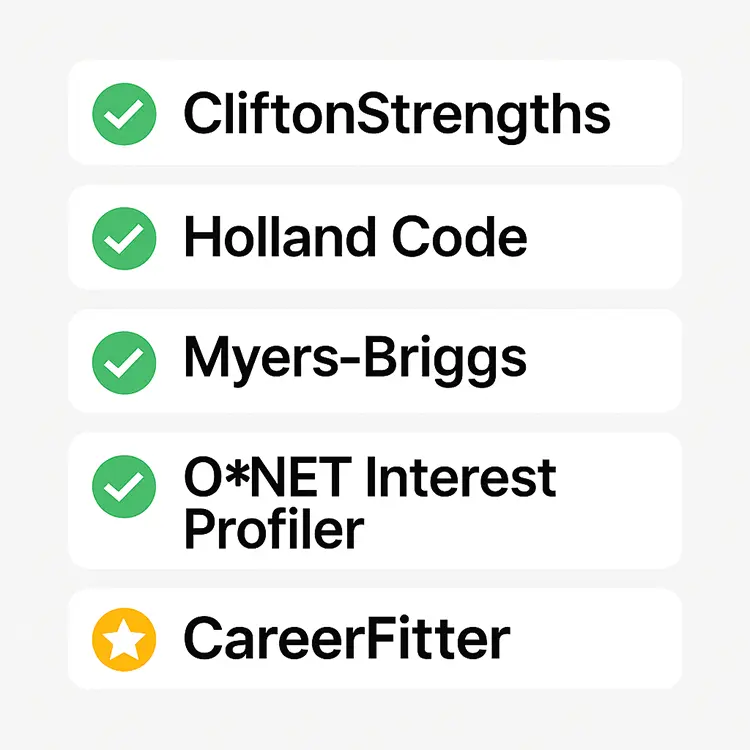
CareerFitter: Work Personality and Career Fit
CareerFitter's career test is designed to help you look beyond a broad personality label or general interest category. It connects your work personality and preferences to careers that may fit how you naturally think, work, and make decisions.
One advantage is CareerFitter's Aptitude Aversion Assessment, also called A³. This adds practical fit questions that can affect whether a career feels realistic for you. For example, you may be interested in healthcare, but not comfortable around blood. Or you may like problem-solving, but not want daily travel, confined spaces, or physically intense work.
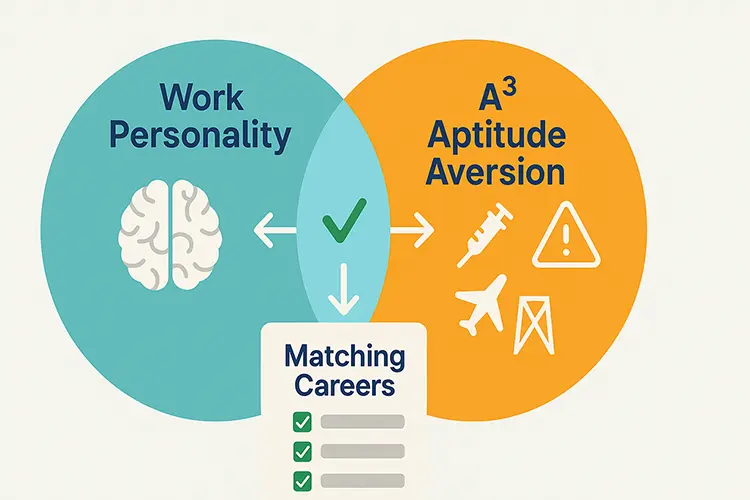
That second layer matters because career fit is not only about what sounds interesting. It is also about what you can see yourself doing day after day. By combining work personality insights with practical fit factors, CareerFitter helps narrow your options to careers that are more realistic, not just theoretically appealing.
This makes the results more useful for students, career changers, and job seekers who want clearer direction before they spend time researching careers or applying for jobs.
Your CareerFitter Personality Fingerprint
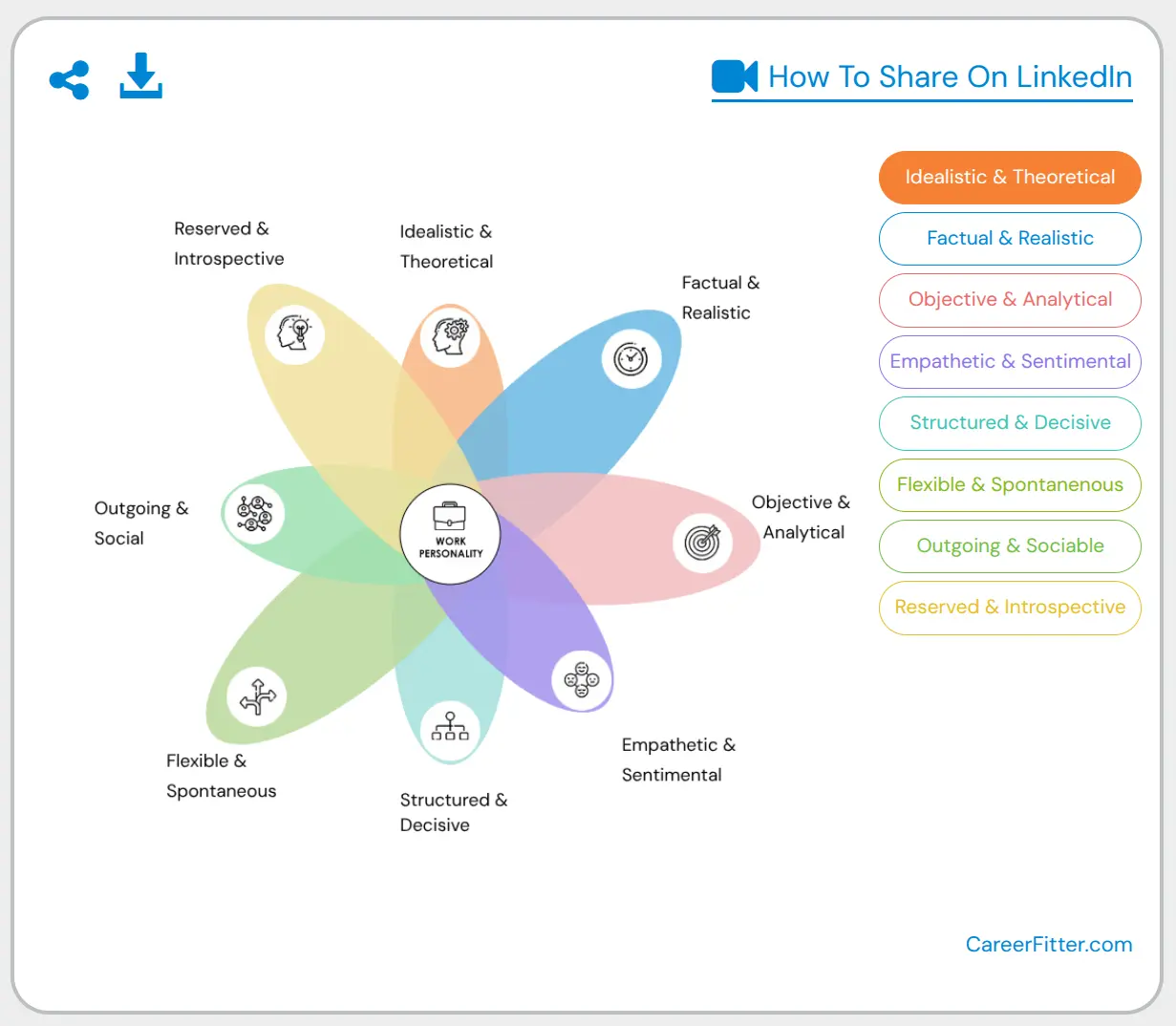
Many career tests give you a broad label or type. CareerFitter gives you a visual Personality Fingerprint that shows how your work personality traits come together in a more personal way.
Instead of reducing your results to one category, the fingerprint helps you see which work traits are strongest for you and how they may influence your career fit. This can make your results easier to understand, remember, and apply when comparing career options.
You can use the Personality Fingerprint as a quick visual summary of how you naturally work, or keep it private as part of your own career planning process.
Results You Can Actually Use
A career test should not leave you with a long report you never finish reading. CareerFitter keeps your first layer of results easy to scan, with clear takeaways about your work personality, strengths, and career direction.
When you want more detail, you can go deeper into your matched careers, including salary ranges, growth outlook, education paths, job descriptions, and related O*NET career videos. Instead of giving you one static personality report, CareerFitter turns your results into a career dashboard with tools you can use to compare options, research careers, and plan your next step.
Filters to Narrow Your Career Matches
A long list of career matches can still feel overwhelming. CareerFitter helps you narrow your results with filters for practical factors like salary, education level, remote work, and travel.
That matters because the right career needs to fit your real life, not just your personality. You can focus on careers that match your strengths while also fitting your goals, lifestyle, and non-negotiables.
Bottom line: CareerFitter helps you move from a broad list of possible careers to a more focused list of realistic options.
Career Research and Job-Market Context
CareerFitter does more than give you a list of career names. Each matched career can lead you to more detailed career research, including salary information, job outlook, education requirements, skills, and related career details.
This helps you move from "this career sounds interesting" to "this career makes sense for me." You can compare demand, pay, training requirements, and daily work expectations before deciding which careers deserve more of your time.
This is especially helpful if you are comparing careers that sound similar on the surface. Two careers may both match your interests, but one may require more education, more travel, different daily tasks, or a work environment that fits you better.
Turn Your Career Strengths Into Job Search Talking Points
Knowing your best-fit careers is helpful, but you also need to explain why you fit them. CareerFitter's Career Strengths Report helps you turn your assessment results into clear, role-specific strengths you can use when applying, interviewing, or networking.
Instead of giving you generic personality traits, the report connects your natural work strengths to the career you are targeting. That can help you describe your value in a way that feels more specific, credible, and relevant to employers.
You can use these insights to improve your resume, prepare for interview questions, or explain why a certain career path fits how you naturally work.
Pro tip: If you use a Career Strengths Report in your job search, place the link near your contact information or use it as a preparation tool before interviews.
How Popular Career Tests Compare
Not all career tests are built for the same purpose. Some help you understand your strengths. Others focus on interests, personality type, or occupational data. The best choice depends on what you are trying to figure out.
| Career Test | Best For | What It Measures | Main Limitation |
|---|---|---|---|
| CareerFitter | Finding careers that fit your work personality and preferences | Work personality, career fit, strengths, preferences, and practical fit factors | Best for people who want career direction, not just a general personality label |
| CliftonStrengths | Understanding and naming your natural strengths | Talent themes and strength patterns | Strong for self-awareness and teams, but not designed as a complete career-matching tool |
| Holland Code / RIASEC | Exploring broad career interest categories | Interests across six work themes | Helpful starting point, but broad and less personalized |
| Myers-Briggs Type Indicator | Understanding personality preferences and communication style | Personality type preferences | Popular for self-reflection, but limited for choosing specific careers |
| O*NET Interest Profiler | Exploring careers through U.S. labor data | Career interests connected to O*NET occupations | Free and useful, but focused on interests rather than full work personality fit |
CareerFitter
CareerFitter is designed for people who want more than a general personality label or interest category. It connects your work personality and preferences to career matches, then helps you research those careers more deeply.
CareerFitter stands out because it gives you a ranked list of career matches, a visual Personality Fingerprint, career research tools, and role-specific strength insights. This makes it useful for people who want to move from self-awareness to practical career direction.
CliftonStrengths
CliftonStrengths is useful when you want language for your natural talents. It can help you understand how you tend to think, work, build relationships, and approach goals. Many people like it because the results are easy to discuss with a coach, manager, or team.
The limitation is that CliftonStrengths is not primarily a career-matching test. It can tell you what kinds of strengths you may bring to work, but it does not fully connect those strengths to specific careers, work environments, career research, or job-market details.
Holland Code / RIASEC
The Holland Code is one of the most familiar career-interest models. It groups people and careers into six broad themes: Realistic, Investigative, Artistic, Social, Enterprising, and Conventional. It can be a helpful starting point if you want a quick way to explore career categories.
Its weakness is that broad interest categories do not always explain whether a specific career fits how you naturally work. Two people may share similar interests but need very different work environments, responsibilities, and daily tasks to feel successful.
Myers-Briggs Type Indicator
MBTI is widely known and often used for personality awareness, communication, and team discussions. It can help people think about how they make decisions, manage energy, and interact with others.
For career choice, though, MBTI has limits. A personality type can offer useful self-reflection, but it does not provide a complete picture of career fit. It does not directly compare your results against detailed career demands, job outlook, salary, education paths, or practical career filters.
O*NET Interest Profiler
The O*NET Interest Profiler is free and connected to U.S. Department of Labor career data. It is a solid tool for exploring occupations based on interests and learning more about career options through O*NET.
The tradeoff is that it focuses mainly on interests. It does not provide the same kind of personalized work personality profile, fit scoring, Career Strengths Report, or broader dashboard experience that CareerFitter provides.
Which Career Test Should You Choose?
Choose the career test that matches the decision you are trying to make.
- Choose CareerFitter if you want career matches based on your work personality, preferences, strengths, and practical fit factors.
- Choose CliftonStrengths if your main goal is to name and understand your natural strengths.
- Choose Holland Code / RIASEC if you want a quick way to explore broad career-interest categories.
- Choose MBTI if you want a familiar personality framework for self-reflection or communication style.
- Choose O*NET Interest Profiler if you want a free interest-based tool connected to occupational data.
If your goal is career direction, not just self-awareness, look for a test that connects your results to real career options. That is where CareerFitter is strongest. It helps you understand how you work, which careers may fit, and what to research next.
When a Career Advisor May Help
A self-guided career test can take you far, especially when you are exploring options or trying to narrow a long list of possibilities. But if you are making a major career change, returning to work, choosing a college major, or feeling stuck after reviewing your results, a career advisor can help you turn those insights into a step-by-step plan.
The best approach is often simple: use a strong career test first, then bring your results to a counselor, advisor, coach, or mentor if you want help making a final decision.
Want to find the best career for your personality?
Take CareerFitter's free career test and get personalized career matches based on how you naturally work.
Start the Free Career TestFrequently Asked Questions
What is the best career test?
The best career test depends on your goal. If you want broad self-awareness, a personality or strengths test may help. If you want career direction, choose a test that connects your results to specific career matches, work preferences, and practical research tools.
Is CareerFitter free?
CareerFitter offers a free career test with instant high-level results. Premium options are available if you want deeper career matches, expanded reports, and additional career tools.
How long does the CareerFitter test take?
The free CareerFitter career test is designed to be completed quickly. The exact time can vary depending on how you answer and whether you choose to continue into additional tools or Premium results.
Is O*NET Interest Profiler a good career test?
Yes, the O*NET Interest Profiler is a useful free tool for exploring occupations based on interests. It is especially helpful if you want to browse U.S. occupational data. Its limitation is that it focuses on interests, not full work personality fit.
Is MBTI good for choosing a career?
MBTI can help you reflect on your personality preferences and communication style. For choosing a career, it is usually better as a supporting tool, not the only source of guidance.
Should I take more than one career test?
You can, but you may not need to. If one test gives you career matches, personality insights, fit factors, and research tools, that may be enough to start making informed decisions. Taking too many tests can create more confusion if the results do not connect to clear next steps.
How often should I retake a career test?
Retake a career test when your goals, work preferences, or life circumstances change in a meaningful way. For many people, that happens after graduation, burnout, a major job change, or a career transition.


.avif)


