.avif)

.png)


How to Get a Job in AI Without a Degree: 5 Entry-Level Jobs
AI is creating new career paths, but the best first job may not be the one with the flashiest title.
You do not need a college degree to start working near AI. You do need a realistic entry point, practical skills, and proof that you can use AI carefully. Most beginners without a degree do not start as machine learning engineers or AI researchers. Those roles usually require deeper technical training, advanced math, programming experience, or formal education.
A better first step is to target jobs where you help evaluate, organize, test, improve, or apply AI systems. These roles can involve reviewing AI responses, cleaning data, testing AI tools, building simple automations, or helping teams use AI more effectively.
The World Economic Forum’s 2025 Future of Jobs coverage identifies AI, big data, technology literacy, and related roles as major areas of labor-market change. That does not mean every beginner should chase advanced AI engineering. It means practical AI skills are becoming useful across more jobs.
This guide shows you how to get a job in AI without a degree, which entry-level AI jobs are most realistic, what skills to build first, and how to prove you can do the work.

Key Takeaways
- You can get a job in AI without a degree, but you need proof of skill.
- The most realistic beginner AI jobs involve evaluating, testing, organizing, or applying AI systems.
- Prompt engineering is better treated as a useful skill, not the safest standalone career target.
- A small portfolio with real examples is usually more useful than certificates alone.
- Your best path depends on whether your strengths fit data, quality testing, writing, automation, research, or operations work.
Can You Really Get a Job in AI Without a Degree?
Yes, but not every AI job is equally realistic.
The phrase “AI job” can mean several different things. Some roles involve building AI systems. Others involve using AI tools, testing AI products, reviewing AI output, preparing data, or helping businesses apply AI in daily workflows.
If you want to become a machine learning engineer, AI researcher, or computer and information research scientist, you will usually need deeper technical training. Those jobs can be excellent, but they are not usually the easiest starting point for someone with no degree and no experience.
Your better first move is to target AI-adjacent roles where employers care about accuracy, judgment, documentation, data handling, testing, workflow improvement, and practical tool use. If you are comparing broader options beyond AI, CareerFitter’s guide to fast-growing jobs that do not require a degree can help you see other paths that may also fit your goals.
What Counts as an Entry-Level AI Job?
An entry-level AI job is a role where you contribute to AI-related work without needing to design advanced models from scratch.
You may help answer questions like:
- Is this AI response accurate, safe, useful, and relevant?
- Is the training data clean and labeled correctly?
- Did the AI tool fail in a predictable way?
- Can this workflow be improved with automation?
- Can this team use AI without creating errors or risks?
That work is valuable because AI systems still need human review, testing, judgment, and context. Even as tools improve, companies need people who can spot mistakes, document problems, compare outputs, and help AI fit into real business processes.
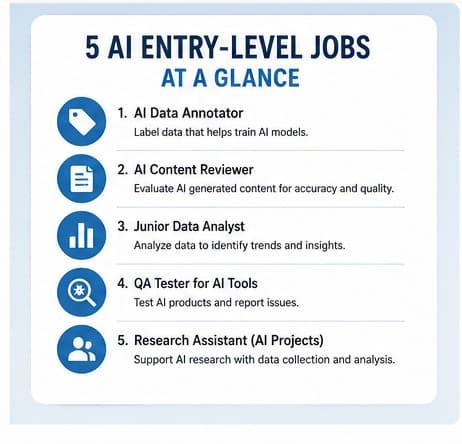
5 AI Entry-Level Jobs at a Glance
| Entry-Level AI Job | Best For | What You Prove First |
|---|---|---|
| AI Data Annotation Specialist | Detail-oriented beginners | Accuracy, labeling, and data consistency |
| AI Evaluator or AI Response Rater | Strong readers and researchers | Judgment, fact-checking, and response scoring |
| AI Quality Assurance Tester | Troubleshooters | Test cases, bug reports, and edge-case thinking |
| Junior Data Analyst Using AI Tools | Pattern-finders | Spreadsheet, SQL, and data-cleaning basics |
| AI Workflow Automation Assistant | Process-minded problem solvers | Workflow mapping, AI tool use, and documentation |
5 Entry-Level AI Jobs You Can Get Without a Degree
1. AI Data Annotation Specialist
An AI data annotation specialist labels, reviews, organizes, or improves data used to train or evaluate AI systems. You might tag images, classify text, review search results, label audio, check categories, or follow detailed instructions to help an AI system learn patterns.
This can be one of the most realistic entry points if you are new to AI because it often values consistency, attention to detail, and the ability to follow guidelines more than a formal degree.
Build first: spreadsheet basics, labeling guidelines, pattern recognition, quality control, and clear written notes.
2. AI Evaluator or AI Response Rater
An AI evaluator reviews AI-generated answers and scores them for accuracy, helpfulness, safety, tone, and relevance. You may compare two AI responses, check facts, flag unsafe answers, judge whether an answer follows instructions, or explain why one response is better than another.
This is a better target than chasing “prompt engineer” as a standalone role. Prompting still matters, but many employers now expect it as part of broader evaluation, writing, testing, analysis, or operations work.
Build first: fact-checking, prompt evaluation, source checking, writing, bias awareness, and consistent scoring.
3. AI Quality Assurance Tester
An AI quality assurance tester checks AI tools for errors, unexpected behavior, confusing responses, bugs, and poor user experiences. Traditional software QA focuses on whether an app or system works correctly. AI QA adds another layer: you may need to test whether an AI tool gives reliable, relevant, safe, and consistent responses.
For the broader QA and software-testing field, the U.S. Bureau of Labor Statistics projects software developers, quality assurance analysts, and testers to grow 15% from 2024 to 2034.
Build first: QA basics, bug reporting, test cases, edge-case thinking, documentation, and basic AI tool knowledge.
4. Junior Data Analyst Using AI Tools
A junior data analyst collects, cleans, reviews, and explains data so a business can make better decisions. This role is not always branded as an “AI job,” but it is one of the strongest long-term paths into AI-related work because AI depends heavily on data.
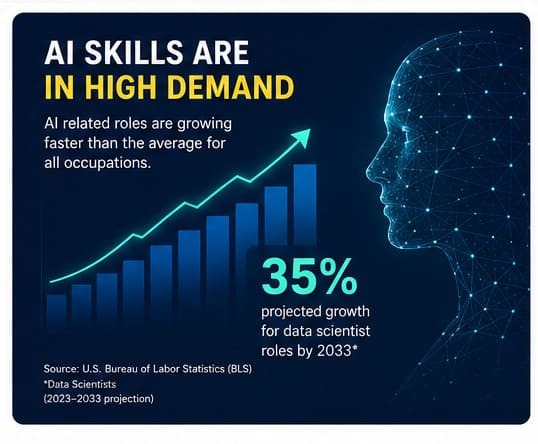
You may not start as a data scientist without a degree, but junior data analyst work can help you build toward more advanced data and AI roles. The U.S. Bureau of Labor Statistics projects data scientist employment to grow 34% from 2024 to 2034, which supports why data skills can be a strong bridge into AI-related work.
Build first: Excel or Google Sheets, SQL basics, data cleaning, dashboards, basic statistics, and AI-assisted analysis.
5. AI Workflow Automation Assistant
An AI workflow automation assistant helps teams use AI tools to save time, reduce repetitive work, and improve business processes. You might help automate intake forms, summarize customer messages, organize internal documents, draft repeatable templates, connect apps, or build simple workflows using tools like Zapier, Make, Airtable, Notion, Google Workspace, or AI assistants.
This role fits the current direction of AI hiring because many companies do not only need people who can build AI models. They need people who can apply AI to real work.
Build first: AI tool fluency, process mapping, no-code automation, documentation, communication, and basic troubleshooting.
Skills You Need to Get an AI Job Without a Degree
You do not need every AI skill to get started. You need the right skill stack for the kind of entry-level AI work you want. That means building both technical abilities and workplace skills, similar to the balance explained in CareerFitter’s guide to hard skills vs. soft skills.
Focus rule: Choose one entry path, build the matching skills, then prove them with two or three portfolio projects.
| Skill Area | Why It Matters | Best Fit Roles |
|---|---|---|
| AI output evaluation | Helps you test accuracy, clarity, tone, safety, and instruction-following | AI evaluator, AI QA tester, content quality |
| Data and spreadsheet basics | Helps you clean, organize, label, and summarize information | Data annotation, data quality, junior data analyst |
| QA and documentation | Helps you report errors, repeat tests, and explain what happened | AI QA tester, product support, evaluator |
| Workflow automation | Helps you find repetitive work and build safer AI-assisted processes | AI workflow automation assistant, operations |
| Communication and judgment | Helps you explain results, limits, risks, and next steps clearly | All entry-level AI paths |
What to Learn First
The fastest path is not learning everything. The fastest path is learning in the right order.
- Learn basic AI literacy. Understand what generative AI is, why AI makes mistakes, why data matters, and why human review is still needed.
- Practice one or two AI tools deeply. Choose one general AI assistant and one tool related to your target path.
- Build spreadsheet confidence. Learn sorting, filtering, formulas, cleanup, pivot tables, charts, and simple dashboards.
- Learn how to evaluate AI output. Practice scoring answers for accuracy, completeness, tone, safety, source quality, and instruction-following.
- Add role-specific skills. Learn SQL for data roles, QA basics for testing roles, or no-code automation tools for workflow roles.
This order helps you avoid scattered learning. You can always add Python, machine learning, cloud tools, or advanced analytics later if your path moves toward more technical AI work.
Portfolio Projects That Help You Get Hired
If you do not have a degree, your portfolio becomes one of your strongest proof points. A certificate can show that you completed training. A portfolio shows that you can apply what you learned. If you are deciding whether a credential is worth the time or cost, CareerFitter’s guide to job certifications can help you evaluate that choice.
A strong beginner AI portfolio should show the problem, tools used, steps taken, result, manual checks, and what you would improve next.
| Portfolio Project | What to Show | Best Target Roles |
|---|---|---|
| AI response evaluation sample | Compare AI answers with a rubric for accuracy, clarity, tone, safety, and usefulness | AI evaluator, response rater, AI QA |
| Data cleanup and labeling project | Clean a small dataset, standardize categories, flag unclear records, and summarize changes | Data annotation, data quality, junior data analyst |
| AI tool testing report | Test one AI tool against a use case, document failures, and suggest improvements | AI QA tester, product support |
| Simple dashboard using AI-assisted analysis | Use a small dataset to create charts, summarize patterns, and explain what you verified manually | Junior data analyst, data operations |
| Workflow automation case study | Map a repetitive task, build a simple AI-assisted workflow, and show where human review happens | AI workflow automation, operations |
You do not need ten projects. Two or three strong examples that match your target role are better than several unrelated samples. Avoid portfolio examples that only show AI-generated writing, copied prompts, or generic screenshots. Show how you improved something, tested something, organized something, or made a workflow clearer.
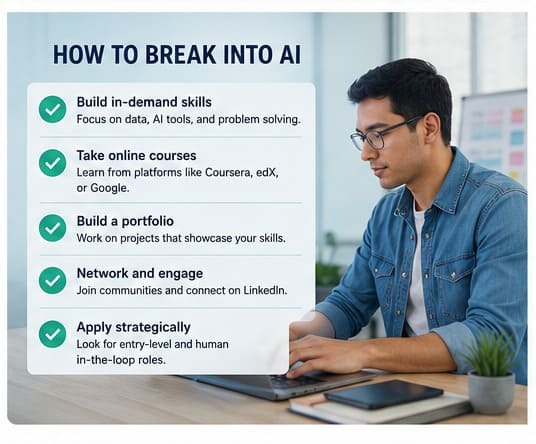
How to Apply for AI Jobs Without a Degree
Getting an AI job without a degree is partly about skill. It is also about applying for the right roles. Many beginners search only for “AI jobs” and end up competing for roles that require computer science degrees, machine learning experience, or several years of software engineering work.
Search tip: Some beginner AI jobs will not have AI in the title. Search for evaluation, data quality, QA, automation, support, and operations roles that mention AI in the description.
Search for realistic job titles
Try searches such as AI evaluator, AI response rater, AI data annotation specialist, data quality analyst, AI quality assurance tester, AI content quality analyst, junior data analyst, automation assistant, workflow automation assistant, AI operations assistant, chatbot tester, customer support AI specialist, and AI trainer.
Also search broader titles that may include AI work inside the job description, such as operations assistant, customer support specialist, research assistant, product support specialist, QA analyst, data coordinator, and business operations assistant. CareerFitter’s review of the best online job search websites can help you compare where to search.
Build a proof-first resume
If you do not have a degree, your resume needs to lead with proof. Put your most relevant projects, tools, and measurable examples near the top. A generic AI resume will not perform well, especially as more hiring systems use automation and AI screening. CareerFitter’s guide to how hiring changed in 2026 explains why targeted resumes and clear evidence matter more now.
If you use AI to draft or tailor your resume, CareerFitter’s guide on how to use ChatGPT to write a resume can help you do that more carefully.
For example, instead of writing “interested in AI,” write: “Entry-level AI evaluator candidate with portfolio projects in response rating, fact-checking, prompt testing, and AI output review.”
Match your proof to the job
If the job focuses on AI evaluation, highlight response rating, fact-checking, rubrics, source checking, and safety review. If the job focuses on data annotation, highlight labeling, data cleanup, pattern recognition, accuracy, and spreadsheet work. If the job focuses on automation, highlight workflow mapping, no-code tools, AI summaries, process improvement, and human review steps.
Your goal is to make the employer think, “This person has already practiced the work we need.”
Mistakes to Avoid
AI career advice can sound either too easy or too impossible. The truth is in the middle. You can enter AI without a degree, but you need a focused path, real proof, and honest expectations.
1. Chasing only “prompt engineer” jobs
Prompting is useful, but it is not the safest beginner job target by itself. Learn prompt testing, then connect it to evaluation, QA testing, content quality, data analysis, customer support, workflow automation, or product support.
2. Applying only to machine learning engineer roles
Machine learning engineer is a strong career goal, but it is usually not the easiest first AI job without a degree. Start with roles that build related proof, such as junior data analyst, data quality specialist, AI evaluator, AI QA tester, technical support specialist, automation assistant, or software QA tester.
3. Relying on certificates without projects
Certificates can help, but they are not enough by themselves. Pair every course or certificate with a project, such as a dashboard, AI response evaluation sample, QA testing report, automation workflow, or data cleanup project.
4. Making unsupported salary claims
Be careful with viral posts that claim you can make six figures quickly in AI with no degree and no experience. Entry-level AI support roles vary widely by company, location, contract type, and required skill level. To compare AI against other long-term options, see CareerFitter’s guide to the best jobs for the future.
5. Claiming expert-level AI skills too soon
Do not call yourself an AI expert because you have used ChatGPT, Gemini, Claude, or another tool for a few months. It is stronger to say exactly what you can do, such as evaluate AI responses, compare outputs with a rubric, clean spreadsheet data, document AI failures, or build a workflow with human review.
6. Using private data in portfolio projects
Never use private company data, customer information, confidential documents, internal messages, or personal records in a public portfolio. Use public datasets, made-up sample data, open-source examples, or redacted samples with permission.
Is an AI Career Without a Degree Right for You?
AI can be a strong career direction, but it is not the right fit for everyone. The field changes quickly. Tools improve, job titles shift, and employers adjust what they need. That can be exciting if you like learning and experimenting. It can feel frustrating if you prefer stable routines and slow-changing systems.
You may be a good fit for entry-level AI work if you like learning new tools, testing how systems respond, checking details, organizing messy information, comparing options, improving repeatable processes, or asking why something failed.
You may struggle if you dislike reviewing imperfect output, repeating tests, documenting small details, working with ambiguity, updating your skills often, or using technology every day.
Match the AI path to your strengths
| If you are strongest at... | Consider starting with... |
|---|---|
| Detail and accuracy | AI data annotation or data quality |
| Reading, writing, and judgment | AI evaluator or AI response rater |
| Troubleshooting and testing | AI quality assurance tester |
| Numbers, patterns, and reports | Junior data analyst using AI tools |
| Organizing workflows and saving time | AI workflow automation assistant |
Use CareerFitter to check career fit before you commit
If you are unsure which AI path fits you, a career assessment can help you compare your strengths, work personality, and preferred work environment before you spend time on the wrong training path.
CareerFitter’s career test can match you to careers based on your personality and give you a starting point for understanding the type of work that may fit you best. If you want a deeper look, the Career Strengths Report can help you connect your strengths to career options and explain those strengths more clearly to employers.
Use that insight as one part of your decision. You should still compare job requirements, build projects, and test the work before fully committing.
FAQ: Getting a Job in AI Without a Degree
Can I get a job in AI without a degree?
Yes. Your first role may not be an advanced AI engineering job, but you can target jobs where you evaluate AI responses, label data, test AI tools, clean information, support AI products, or build simple AI-assisted workflows.
What is the easiest AI job to get without a degree?
Common beginner-friendly options include AI data annotation specialist, AI evaluator, AI response rater, AI content quality reviewer, chatbot tester, and data quality assistant. These roles often value attention to detail, reading ability, judgment, and consistency.
Do AI jobs require coding?
Some AI jobs require coding, but not all of them. You will usually need coding for machine learning engineer, AI engineer, data engineer, or software developer roles. You may not need coding for AI evaluation, data annotation, content quality, chatbot testing, customer support, or basic workflow automation.
Is prompt engineering still a good career?
Prompt engineering is still a useful skill, but it is not the safest standalone beginner career plan. Many employers now expect workers to use prompts as part of broader jobs, such as AI evaluation, content editing, data analysis, QA testing, customer support, and workflow automation.
What should I put in an AI portfolio?
Include projects that show how you think and work, such as an AI response evaluation sample, data cleanup project, AI tool testing report, simple dashboard, or workflow automation case study. Explain the problem, tools used, steps taken, result, human review process, and what you would improve next.
Can I work remotely in an entry-level AI job?
Some entry-level AI roles are remote, especially AI evaluation, data annotation, content quality, and contract-based response rating work. You can also compare broader remote options in CareerFitter’s guide to highest-paying work-from-home jobs. Other roles may be remote, hybrid, or in office depending on the company.
Are AI certificates worth it?
AI certificates can be useful if they teach practical skills and help you build projects. They are less useful if they only give you a badge without proof that you can do the work. Do not collect certificates instead of building proof.